Fourteenth Amendment Pope

“…nor deny to any person within its jurisdiction the equal protection of the laws.”

Fourteenth Amendment, ratified July 9, 1868

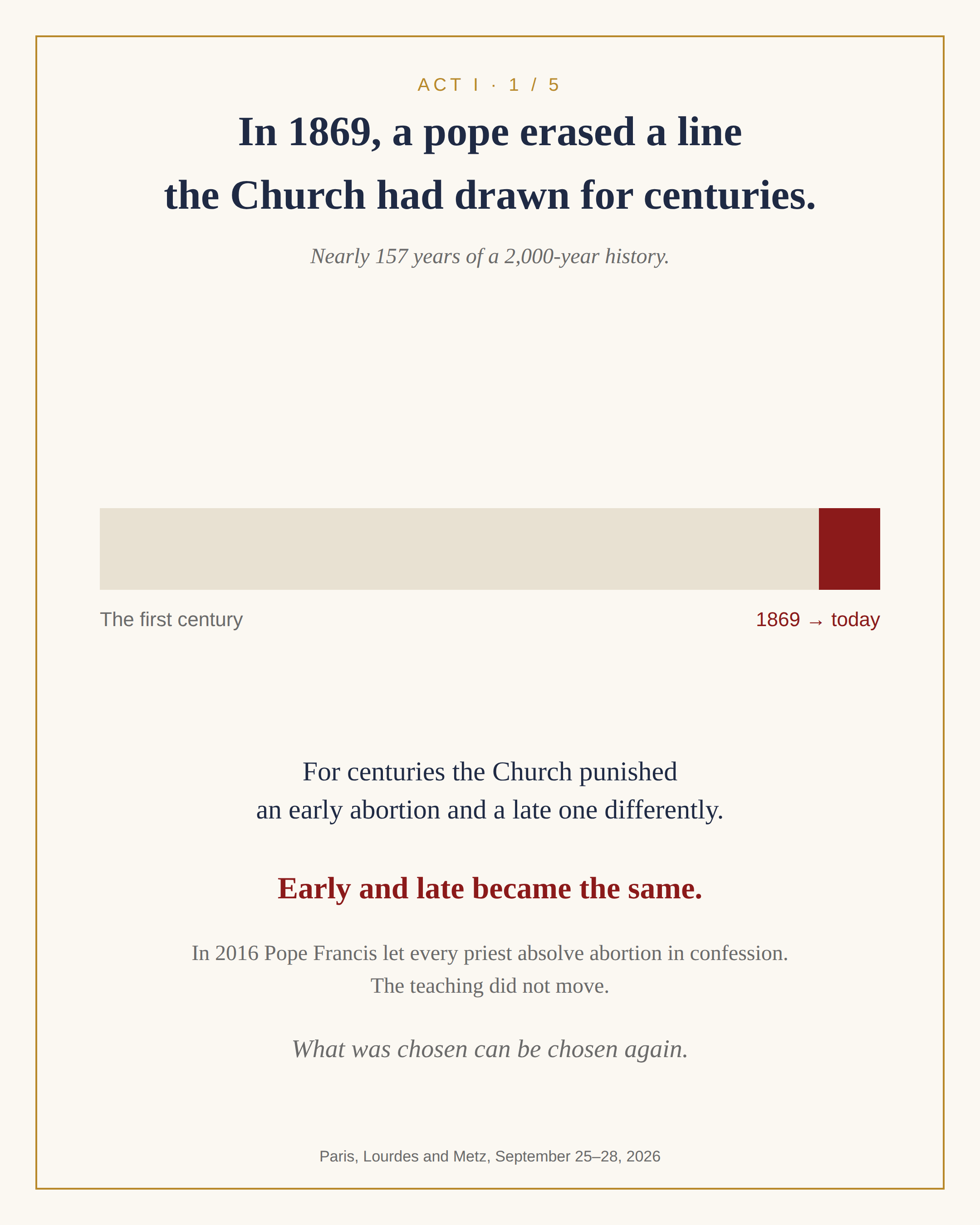
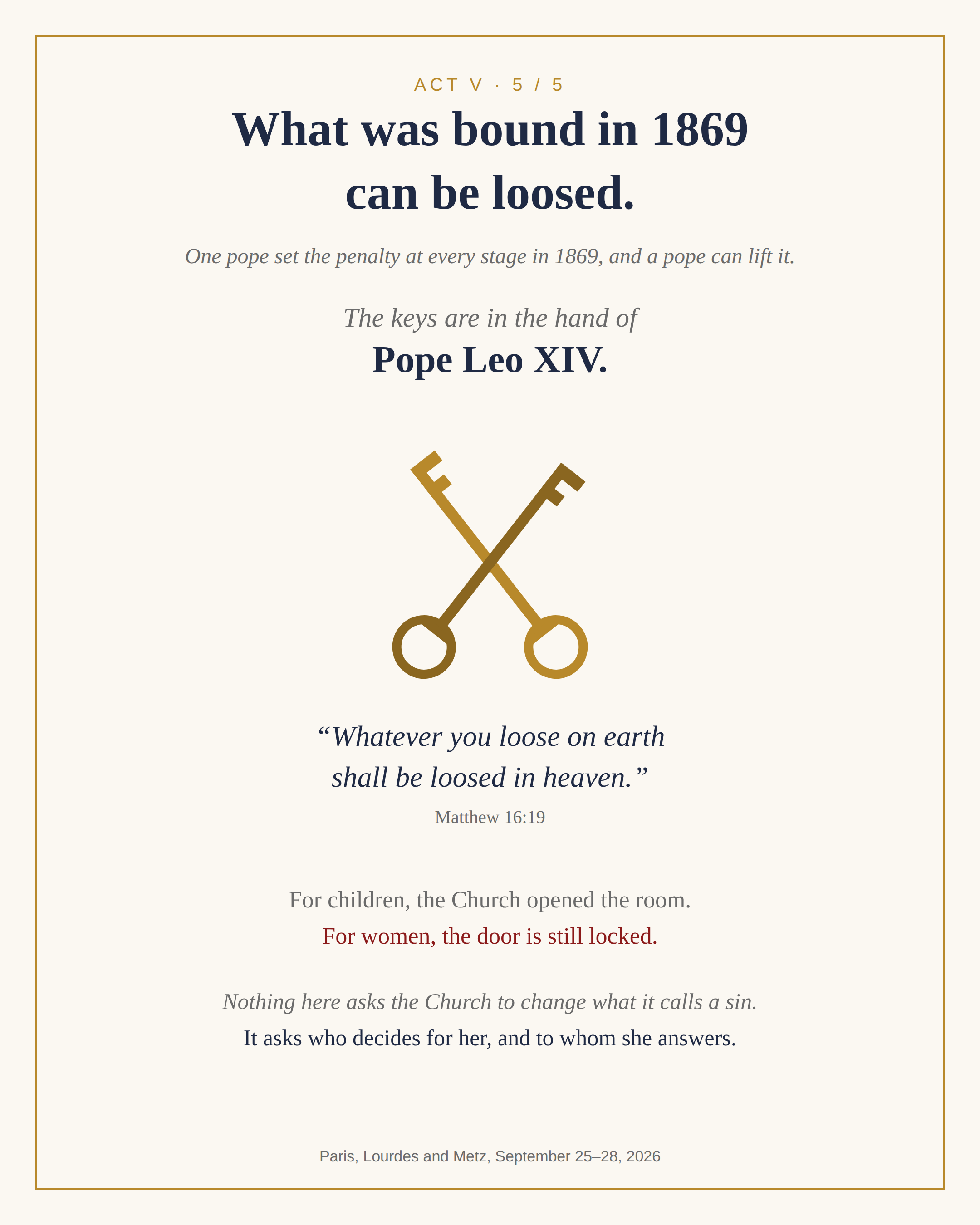
What was bound in 1869 can be loosed.

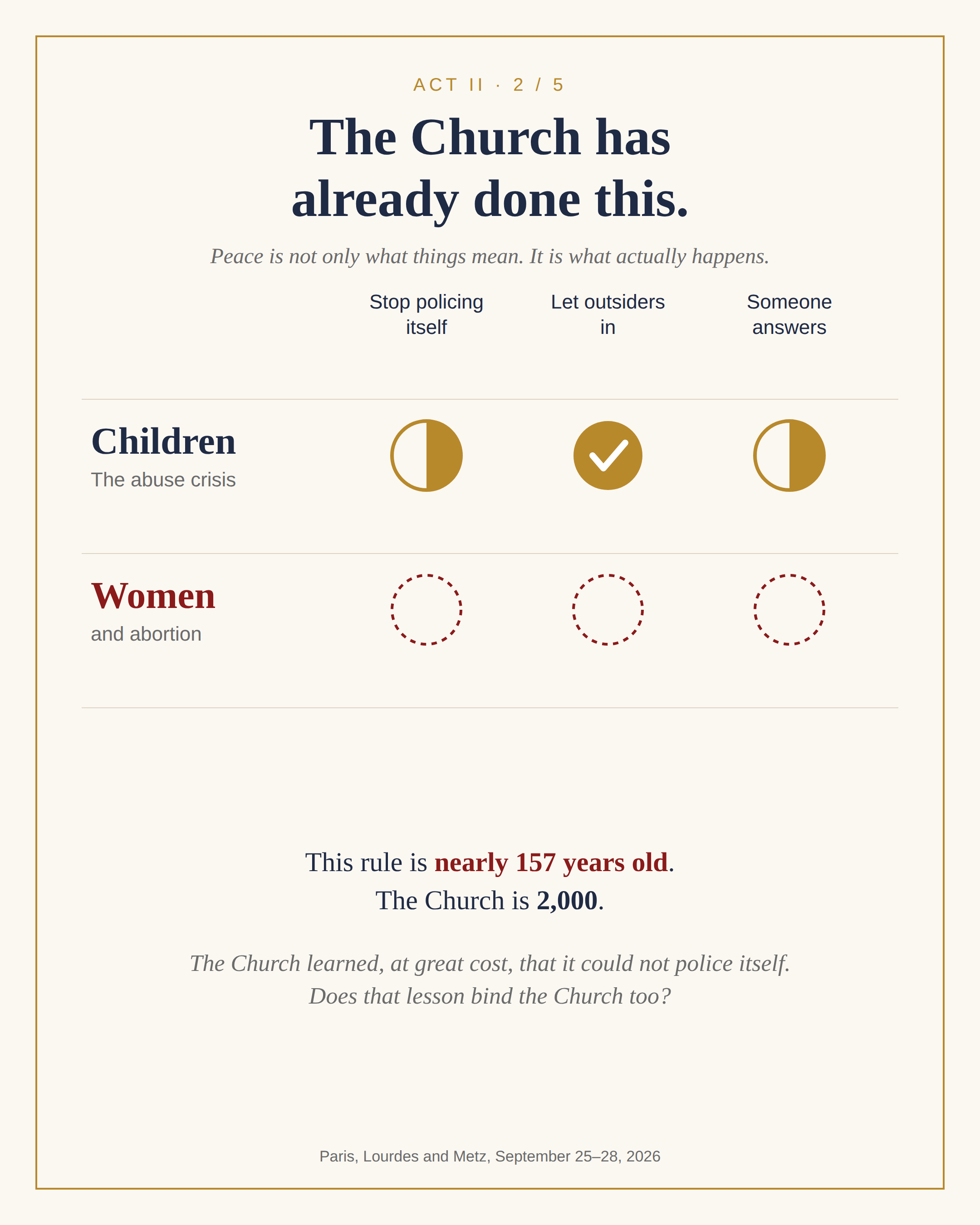
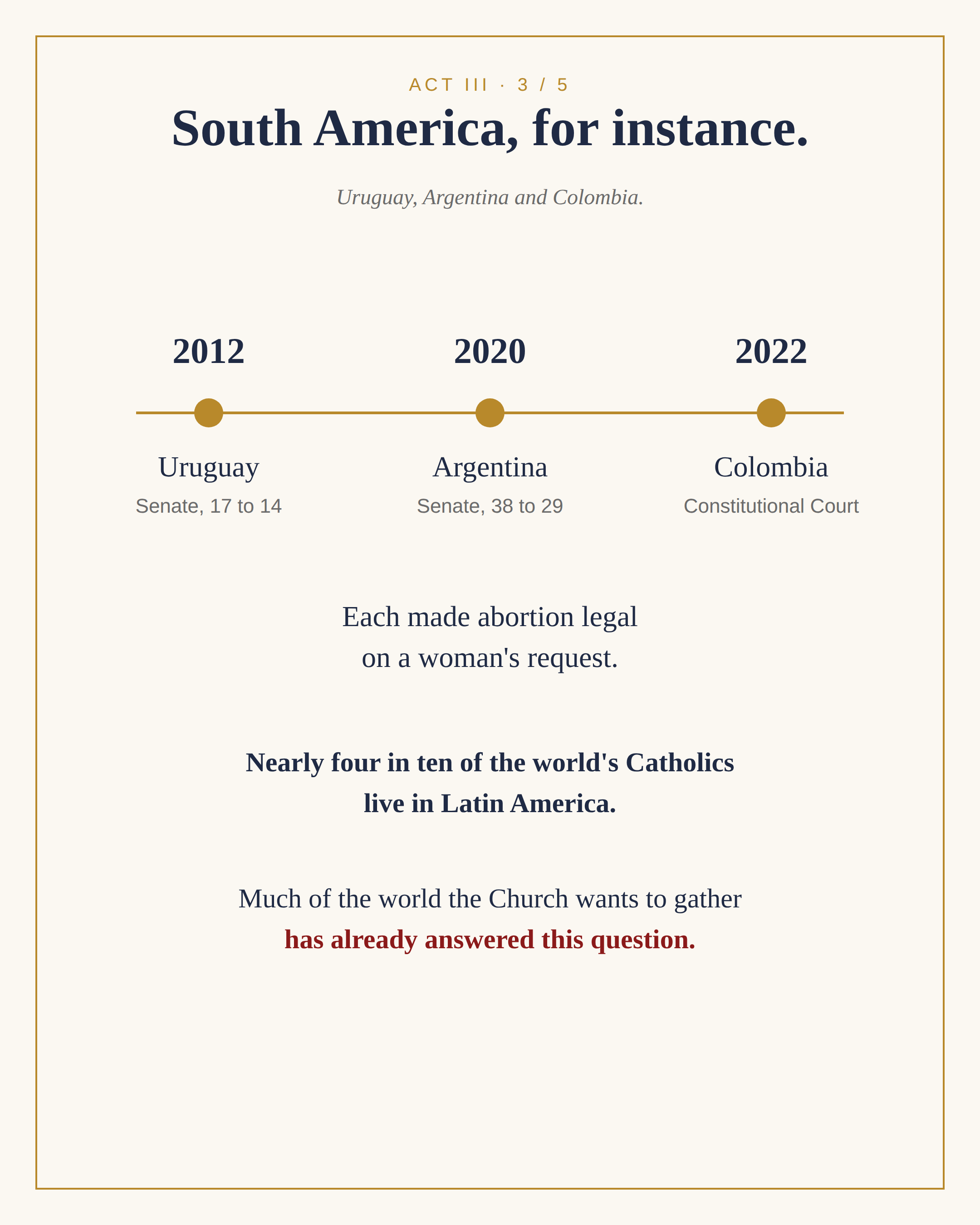
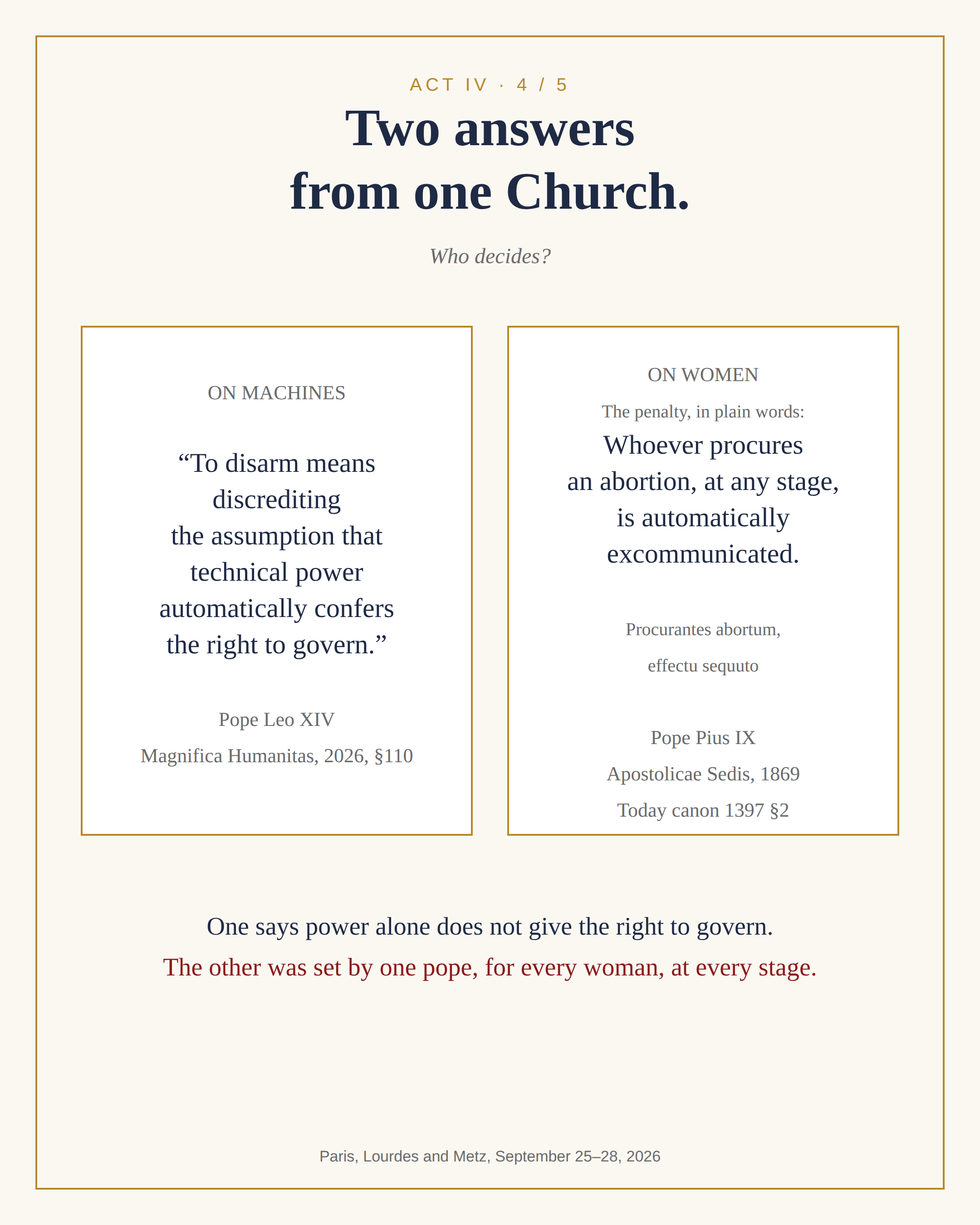
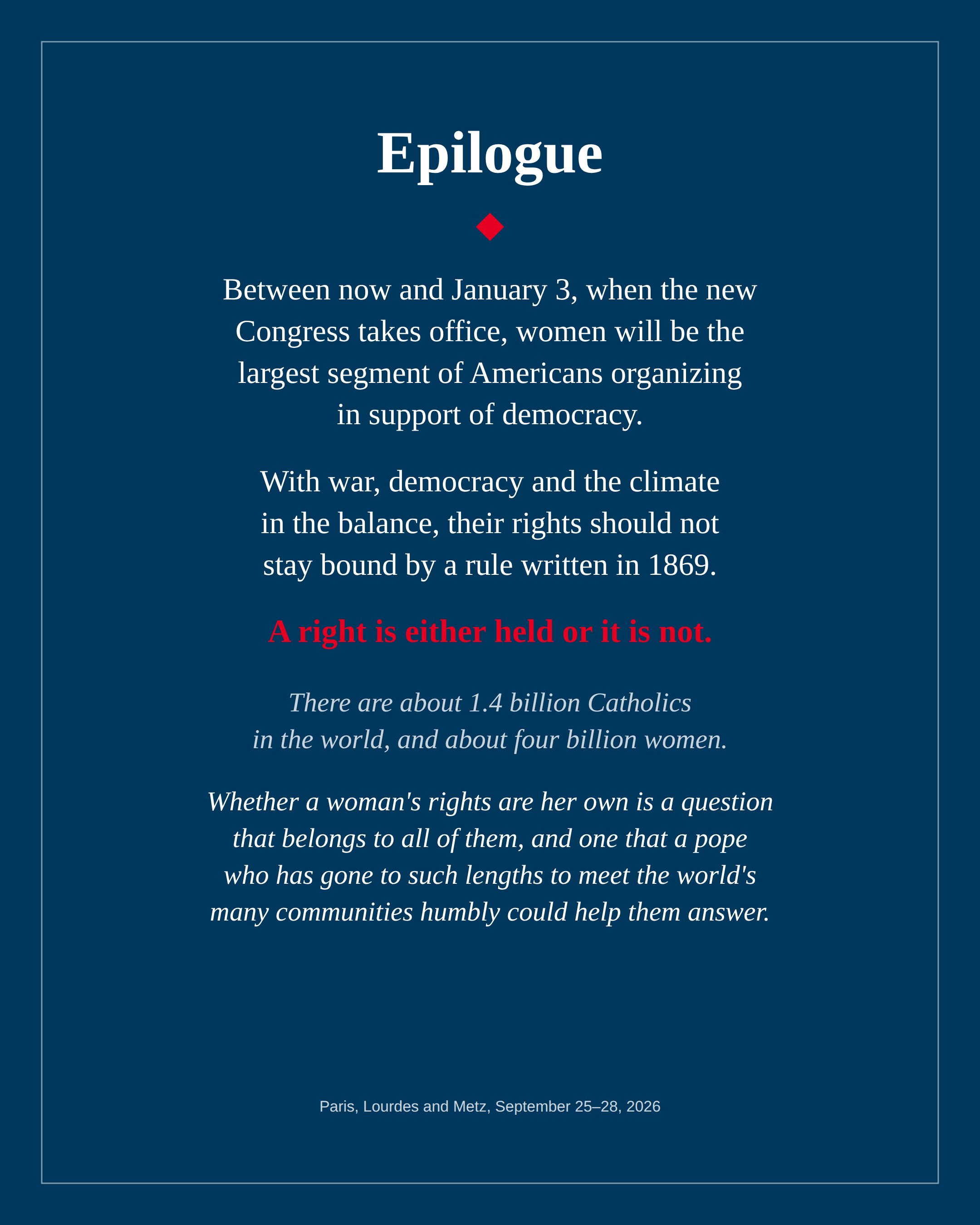
Act I. In 1869, a pope erased a line the Church had drawn for centuries: Nearly 157 years of a 2,000-year history. For centuries the Church punished an early abortion and a late one differently, and in 1869 early and late became the same. In 2016 Pope Francis let every priest absolve abortion in confession, and the teaching did not move. What was chosen can be chosen again. Act II. The Church has already done this. A scorecard: on the abuse of children the Church has partly stopped policing itself, has let outsiders in, and someone answers in part; on women and abortion it has done none. This rule is nearly 157 years old and the Church is 2,000. The Church learned, at great cost, that it could not police itself. Does that lesson bind the Church too? Act III. South America, for instance: Uruguay in 2012, by a Senate vote of 17 to 14; Argentina in 2020, by a Senate vote of 38 to 29; Colombia in 2022, by its Constitutional Court. Each made abortion legal on a woman's request. Nearly four in ten of the world's Catholics live in Latin America. Much of the world the Church wants to gather has already answered this question. Act IV. Two answers from one Church. Who decides? On machines, Pope Leo XIV, Magnifica Humanitas 110, 2026: to disarm means discrediting the assumption that technical power automatically confers the right to govern. On women, the penalty in plain words, Pope Pius IX, Apostolicae Sedis, 1869, today canon 1397 §2: whoever procures an abortion, at any stage, is automatically excommunicated. One says power alone does not give the right to govern; the other was set by one pope, for every woman, at every stage. Act V. What was bound in 1869 can be loosed. One pope set the penalty at every stage in 1869, and a pope can lift it. The keys are in the hand of Pope Leo XIV. Whatever you loose on earth shall be loosed in heaven, Matthew 16:19. For children, the Church opened the room. For women, the door is still locked. Nothing here asks the Church to change what it calls a sin. It asks who decides for her, and to whom she answers. Epilogue. Between now and January 3, when the new Congress takes office, women will be the largest segment of Americans organizing in support of democracy. With war, democracy and the climate in the balance, their rights should not stay bound by a rule written in 1869. A right is either held or it is not. There are about 1.4 billion Catholics in the world, and about four billion women. Whether a woman's rights are her own is a question that belongs to all of them, and one that a pope who has gone to such lengths to meet the world's many communities humbly could help them answer.

The Pope chose his name, and wrote his first encyclical, with artificial intelligence and work in mind, and that argument would carry great weight even if nothing else were at stake. Our moment in time finds far more at stake, with the war in Ukraine, the fragile ceasefire in Gaza and the war with Iran, democracy on the line in the country of the Pope’s birth, and ocean temperatures near the brink. Whether those wars slow or spread will turn, more than anyone outside America likes to say, on who holds Congress after January 3. Catholics everywhere, and people the world over, have a stake in the same three months. With that much in the balance, the rights of women and the work that is theirs should not stay bound by a rule written in 1869, in the age of the first great industrial revolution. A right is either held or it is not, and for the workers’ pope to leave that rule in place would risk abandoning women at the moment their weight could tip the scales.

Lord, you gave Peter the keys to loose as well as to bind, so how long will the women of your Church wait for what was bound in 1869 to be loosed?

For and against

The cards are the case for. These are the objections it expects, and the answers.

"The Church has always condemned abortion."

It has, as a moral teaching, since the first century, and nothing here denies that. In Paris on September 25 the Pope called the protection of the right to life the foundation of every other human right, without naming abortion. What changed over the centuries was whether an early abortion counted as homicide, and how heavily the Church's own law punished it.

"You are asking the Church to change its teaching."

The ask is narrower than that: that a pope lift the automatic penalty set for every stage in 1869, and that the Church stop requiring every state to punish what it considers a sin, a distinction its own greatest theologian drew, because what the Church teaches its members and what it demands of every state are two different things.

"Aquinas himself says the law should forbid murder."

He does, in the same passage, and he also held that an early abortion was not homicide, because he believed the soul arrived later in pregnancy. That was the line the Church kept until 1869, so the Summa supports this argument only when it is read alongside that history; read on its own it cuts the other way, and it should be read honestly.

"Human laws do not forbid all vices, from which the virtuous abstain, but only the more grievous vices, from which it is possible for the majority to abstain; and chiefly those that are to the hurt of others, without the prohibition of which human society could not be maintained: thus human law prohibits murder, theft and such like."
From the Summa Theologiae I-II, question 96, article 2

"The health and life of the mother is already covered."

It is, and it is beside the point, because the standard here is her freedom, which comes before her health and before any exception. An exception is what you grant to someone who does not hold the right.

"You are using the abuse crisis against the Church."

Nothing here claims that the teaching on abortion caused the abuse. The claim is that both were handled in the same closed room, under the same habit of answering to no one, and that the Church has already begun to open that room for one of them.

"You are not a theologian."

That is true, and this is a prayer from the pews, offered at a moment when the answer matters more than the person praying it.

"This is American politics dressed as theology."

France put it in its constitution in 2024, and voters in several American states have voted on it directly since 2022. The ask is that the Church see the world it hopes to bring together as that world actually is.

Sources and dates
  1. 1588Pope Sixtus V declares every abortion a homicide, at any stage.
  2. 1591Three years later Pope Gregory XIV takes it back, and the old distinction between an early abortion and a late one returns.
  3. July 9, 1868The United States ratifies the Fourteenth Amendment, promising every person the equal protection of the law.
  4. October 12, 1869Pope Pius IX erases the line again, and from then on procuring an abortion at any stage brings automatic excommunication. This is the rule, now canon 1397 §2, that the Church holds today.
  5. 1891Pope Leo XIII writes Rerum Novarum, the Church's founding letter on the rights of workers.
  6. October 17, 2012Uruguay's Senate votes 17 to 14 to allow abortion on request.
  7. November 20, 2016Pope Francis lets every priest absolve abortion in confession. The teaching does not move.
  8. December 30, 2020Argentina's Senate votes 38 to 29 to make abortion legal.
  9. February 21, 2022Colombia's Constitutional Court decriminalizes abortion up to 24 weeks.
  10. March 4, 2024France writes a woman's freedom to choose abortion into its constitution, by 780 votes to 72.
  11. May 8, 2025A man from Chicago is elected Pope and takes the name Leo, after the pope of the workers' letter.
  12. May 2026His first encyclical, on artificial intelligence, calls for discrediting the assumption that technical power automatically confers the right to govern.
  13. September 25–28, 2026The Pope visits France.
  14. November 6–17, 2026The Pope visits Uruguay, Argentina and Peru.
  • Magnifica Humanitas, Pope Leo XIV, signed May 15, 2026, published May 25, 2026, paragraph 110
  • Address at the meeting with the authorities, civil society and the diplomatic corps, Élysée Palace, Paris, Pope Leo XIV, September 25, 2026
  • Misericordia et Misera, Pope Francis, November 20, 2016, paragraph 12
  • Rerum Novarum, Pope Leo XIII, May 15, 1891
  • Apostolicae Sedis moderationi, Pope Pius IX, October 12, 1869; Code of Canon Law, canon 1397 §2
  • Effraenatam, Pope Sixtus V, 1588; Sedes Apostolica, Pope Gregory XIV, May 31, 1591
  • Summa Theologiae, Thomas Aquinas, I-II, question 96, article 2
  • CIASE final report, October 5, 2021
  • Uruguay, Law 18.987 on the voluntary interruption of pregnancy, approved by the Senate 17 to 14 on October 17, 2012
  • Argentina, Law 27.610 on access to the voluntary interruption of pregnancy, approved by the Senate 38 to 29, with one abstention, on December 30, 2020
  • Colombia, Constitutional Court ruling C-055, February 21, 2022
  • Pew Research Center, Religion in Latin America, November 13, 2014 (Latin America is home to nearly 40% of the world's Catholics)
  • Constitutional law n° 2024-200 on the freedom to have recourse to abortion, France, adopted by Parliament in Congress at Versailles, 780 to 72, on March 4, 2024, promulgated March 8, 2024
  • Matthew 16:19 (RSV)